Notice: Undefined index: mSXdJG in /homepages/40/d589178833/htdocs/clickandbuilds/LucasParker/wp-includes/sitemaps/class-wp-sitemaps-provider.php on line 1
Blog – Page 4 – Lucas Parker

Blog

  • The Open Parker Project: 2012

    The Open Parker Project: 2012

    Photography: Oscar Bravo

    I am in the process of redoing every CrossFit Open workout. These are my results and reflections from the 4 workouts of 2012. To learn more about the #OpenParkerProject, read this blog post.

    Reminder: on some weeks, I checked my historical score, while on other weeks, I went in blind, not knowing what number I had to beat.

    In 2012, I recall rolling into the CrossFit Open after a block of Olympic Weightlifting focused training. I was powerful, but lacking capacity. For example, I did not make it to the last round of snatches in 12.2, even though the final weight would have been no problem for me.

    During this chapter of The Open Parker Project in 2016, I still feel relatively out of shape – I’ve only been training for a couple months. However, I believe my baseline level of conditioning has improved over the years. During these workouts I maintained a more consistent pace and required less rest between stations, compared to my fast bursts of power and longer rests in 2012.

    So, if I can regain my power and improve my cycle speed, while continuing to build my capacity, I’ll be in pretty good shape this season.

    12.1

    7 Minute AMRAP
    Burpees (6” touch)

    2012 score: 125
    2016 score: 124

    I DID check my old score

    Things I did well:

    I started with a larger set of fast reps
    I exploded off the floor on every rep

    Things I want to improve on:

    I want to hold a faster RPM through the middle of the workout
    I want to push to failure in the last 1:30

    12.2

    10 Minute AMRAP
    30 reps snatch 75 lbs
    30 reps snatch 135 lbs
    30 reps snatch 165 lbs
    Max reps snatch 210 lbs

    2012 score: 85
    2016 score: 90

    I did NOT check my old score

    Things I did well:

    I stayed relaxed in the first round
    I used short urgent sets in round two

    Things I want to improve on:

    I want to stay aggressive and urgent in round 3
    I want to set up faster on the bar

    12.3

    18 Minute AMRAP
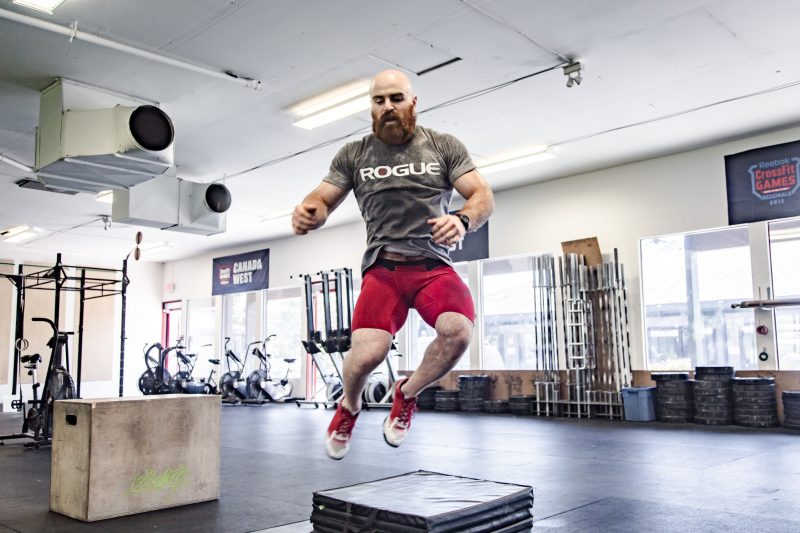
    15 box jumps
    12 push press (115)
    9 toes to bar

    2012 score: 368
    2016 score: 397

    I DID check my old score

    Things I did well:

    I stayed unbroken on the ttb and barbell longer than expected
    I transitioned quickly to the box jumps

    Things I want to improve on:

    I want to pick up the barbell sooner
    I want to shrink my ROM on the push press

    12.4

    12 Minute AMRAP
    150 wallballs
    90 double unders
    30 muscle ups

    2012 score: 264
    2013 score: 265
    2016 score: 276

    I did NOT check my old score

    Things I did well:

    I stayed calm and took short breaks on the wallballs
    I stayed relaxed when I tripped on the rope
    I pushed close to failure on the rings

    Things I want to improve on:

    I want to take a larger first set of wallballs
    I want to go unbroken on the double unders
    I want stronger shoulders for pulling and pushing the muscleups


    Key reflections:

    The burpee workout was a tough loss! I distinctly remember myself bragging to my friends at crossfit NCR, “my score last time was 125. It’s not a question if I’ll beat my old score – the question is how much I’ll beat it by.” I went in confident that my conditioning was superior. However, as discussed last chapter, my biggest gap right now is muscular endurance – I haven’t built up the stamina in my upper body to push through a high volume of a single movement. I am programming a base layer of bodyweight fundamentals each week to address this.

    In contrast, 12.3 was a big victory – one of the biggest I’ve had so far. Still, it could have been bigger. I recall this event in 2012 requiring me to rest more and take breaks on the toes to bar and push press. In preparation for this workout in 2016, I DID go look at my old score. I knew the number to beat and the pace to chase. In the final half of the workout, I was aware that I was ahead of the pace. I felt confident I would beat my old score. This allowed me to relent slightly. Maybe I rested a couple extra seconds between sets. Maybe I relaxed my pace on the box jumps. I still secured a victory, but it involved too much gamesmanship. I want to be decisive and ruthless.

    So, I compare a 12.1 loss with a 12.3 victory – where they share common ground is that I knew my score ahead of time. They also both left a bad taste in my mouth. I’ve always believed that I’m a very calculating athlete: the more information and strategy that I have before competition, the better I will do. However, the evidence so far suggests that prior knowledge may be impeding my performance! I’m curious to see if this pattern continues through the next chapter of The Open Parker Project. 2013 here we come!

  • The Open Parker Project: 2011

    The Open Parker Project: 2011


    I am in the process of redoing every CrossFit Open workout. These are my results and reflections from the 6 workouts of 2011. To learn more about the #OpenParkerProject, read this blog post.

    I’ll start by detailing my results for each workout. I’ll list some things I did well, and some things I want to improve on next time. Afterwards, I’ll summarise my learning experience for this leg of the Open Parker Project.

    Reminder: on some weeks, I checked my historical score, while on other weeks, I went in blind, not knowing what number I had to beat.

    11.1
    10 Minute AMRAP
    30 Double unders
    15 snatches.

    2011 score: 351
    2014 score: 353
    2016 score: 378

    (I DID check my old scores before the WOD)

    Things I did well:

    I had consistent technique on both movements from start to finish.
    I took only short breaks and kept my transitions urgent between exercises.

    Things I want to improve on:

    Maintain unbroken sets of 15 snatches deeper into the workout.
    Have a slightly faster cycle speed or RPM on the barbell.

    11.2
    15 Minute AMRAP
    9 Deadlifts
    12 pushups
    15 box jumps

    2011 score: 452
    2016 score: 409

    (I did NOT check my score before the WOD)

    Things I did well:

    I maintained technique and knee/ankle position on nearly every box jump.
    I started each next round of deadlifts before I felt ready (trusting I can handle the weight and reps)

    Things I want to improve on:

    I want to have faster cycle speed on all movements. Spend less time on each rep and each round.

     11.3
    5 Minute AMRAP
    Squat clean
    +Overhead

    2011 Score: 65
    2016 Score: 68

    (I DID check my old scores before the WOD)

     Things I did well:

    I tried to set up quickly for each repetition

    Things I want to improve on:

    I want to catch my cleans lower
    I want to brace my abs more during the push overhead

     11.4
    10 Minute AMRAP
    60 Burpees
    30 Overhead squats
    10 Muscle ups

    2011 Score: 135
    2016 Score: 143

    (I did NOT check my old scores before the WOD)

     Things I did well:

    My burpees were fast and agressive off the floor
    My burpees were relaxed between reps

    Things I want to improve on:

    I want to rest less between exercises (faster transitions)
    I want to push harder on the second round of burpees

    11.5
    20 Minute AMRAP
    5 Power clean
    10 Toes to bar
    15 Wallball

    2011 Score: 344
    2016 Score: 342

    (I DID check my old scores before the WOD)

     Things I did well:

    I had a quick cycle speed on the power cleans
    I paced the toes-to-bar to my current ability, breaking the 10’s into two sets per round

    Things I want to improve on:

    I want to reduce ROM to improve cycle speed of the wallballs
    I want to rest less after the wallballs and maintain unbroken sets of 15 further into the workout

    11.6
    7 Minute AMRAP
    Thruster
    Chest to bar
    (3,6,9,12…etc)

    2011 Score: 132
    2014 Score: 133
    2016 Score: 135

    (I did NOT check my old scores before the WOD)

     Things I did well:

    I maintained large sets of pullups through the middle of the workout
    I started the later sets of thrusters before I felt ready

    Things I want to improve on:

    I want to cycle both movements faster and minimize my range of motion
    I want to have a higher sense of urgency in the initial rounds, and during the final minute.


    Revisiting all these workouts over 6 weeks was fun!

    My prediction, and hope, was that my past self would prove a worthy adversary. This seems to be the case so far, as my record stands at 4-2, and 3 of my results were within 3 points of my previous score! I’m definitely feeling competitive and motivated to beat my former self.

    The assumption is that “Out of Shape Lucas” in 2016 might loosely match up with “In Shape Lucas” from 2011. Looking ahead to the end of the project, I hope that “Almost In Shape Lucas” in February 2017 will be at least up to speed with “Almost In Shape Lucas” from March 2016.

    My WOD defeats:

    I’m noticing a pattern that makes sense, and that I predict will continue for the next couple chapters of the project. On two workouts, I failed to beat my old score: 11.2 and 11.5. These workouts involved high numbers of pushups and toes to bar, respectively. These movements depend heavily on local muscular endurance. In other words, one’s ability to continue the workout is limited by a specific set of muscles, like the triceps or the hip flexors.

    I’m not overly concerned about this – muscular endurance takes time to develop, and I am starting from a relatively “de-trained” state in the off-season. taking a sneak peek ahead at upcoming workouts in The Open Parker Project, there are plenty of movements like burpees, toes to bar, and pullups, to test the progress of my smaller muscle groups!

    As for how checking my old scores makes a difference on performance, I’m withholding judgement at this time. Hopefully after the 2012 or 2013 set of WODs, I’ll be able to see a clear pattern of how this factor plays a role on alternating weeks.


  • The Open Parker Project

    The Open Parker Project

    Photography: Oscar Bravo


    I present to you the #OpenParkerProject.

    • What is it?

    I am going to redo all the CrossFit Open workouts. I’ve been in the game since 2011, when The Open became the gateway to Carson. I’ll be competing against all my old scores, and documenting my victories (or defeats!) here on the blog. This will involve approximately 26 events and data points (excluding repeats).

    • How am I doing it?

    Once per week, I will do a CrossFit Open workout. Starting with 2011’s events and progressing all the way through the 2016 program.

    Every Friday will be “Game Day.” I want to physically and mentally prepare for Game Day as if I am approaching a 2017 Open workout.

    On some weeks, I will look at my past scores. This will give me a clear target and challenge to attack. On other weeks, I will NOT check my old scores; I’ll just prepare for competition and give my best effort. I think there is value to both scenarios. Effort is always important, but there are different mental approaches  to fighting a known enemy vs. going in blind.

    I will NOT repeat the repeat workouts… for example, 14.1 was the same as 11.1, so I’ll go straight from 13.5 to 14.2. This will save me some time and avoid excessive repetition in the #OpenParkerProject’s condensed format.

    About 6-7 weeks before the 2017 Open, I’ll have to do two events per week, to get them all finished in time.

    • Why am I doing it?

    As an athlete, I want to stimulate my competitive spirit more consistently throughout the year.

    However, I want to avoid the stress and impact of a full weekend event plus travel. I also want to avoid comparing myself to others while I get to work in the offseason; The Open Parker Project will allow me to compete against myself.

    I will get to have a ‘game day” experience each week that will stand in contrast to my regular training. This distinction between training and competing is important. Athletes need to be able to upregulate or downregulate their arousal and energy to meet the task at hand. I’ll get to practice pulling myself together and sharpening my focus for a challenging test, and then incorporating any reflections into the next week of exercise.

    Photography: Oscar Bravo
    Photography: Oscar Bravo
    • Where am I doing it?

    All Around the world! As of writing this, I’ll have done Open workouts in Dublin, Amsterdam, Copenhagen, and Ottawa. Pretty neat! Now that I’m back in Canada, I’ll be throwing down with Games athlete Paul Tremblay at NCR.

    Who am I doing it with?

    The boys at CrossFit NCR have been supportive enough to try some of these WODS with me. They’ve even added them to their affiliate programming on Fridays! I’ll be very interested to see if this has any effect on the overall performance of their box from last year to this year’s CF Open.

    If you want to join me, you can follow along on social media using the hashtag #OpenParkerProject. I’ll be rolling into 2012’s set of workouts with 12.1 on Friday November 18, 2016.

    • Predictions:

    I hope that each week will be an appropriate challenge. It will be interesting to revisit my past performances  – I was a much different athlete in 2011 than I was in, say,  2014, and I’m going to be a different athlete when 2017 comes around.

    Theoretically, my average fitness has increased each year from 2011 to the present. However, right now in the offseason, I am out of shape relative to where I will be in March 2017.

    SO, my grand idea is that the the progression of capacity from 2011 to 2017 will at least loosely parallel my gains in fitness from October 2016 through the next CrossFit Open. In other words, the challenge and efforts to beat my old scores will remain relatively consistent.

  • Attitude Adjustment

    Attitude Adjustment

    Photography: Oscar Bravo

    After the 2016 CrossFit Games, I wrote a blog about how dissatisfied I was with my performance. At the time, my overall outlook was frustrated and negative. I made the choice to publish those feelings, for two reasons: to offer you an open and honest look into one athlete’s experience, and to benchmark my mentality for future comparison.

    It’s taken me 2-3 months, but I’m starting to feel a difference. I’m less focused on the past, and more excited about the future. Better yet, I’m noticing myself grabbing handfuls of moments; being present where I am and making as much progress as I can today. Trying to “seize the carpe,” if you will.

    This is both a conscious pursuit and a natural process.

    It’s a conscious pursuit because I’m striving to nail the basics. I want to do my meditation every day. I covet sleep as if it is steroids. I do things in training that leave me feeling better than when I walked in the gym. I try to express gratitude. All these things support my well-being and my athletic potential.

    Photography: Oscar Bravo
    Photography: Oscar Bravo

    It’s a natural process, because it takes time. Every year after the games, every year, I feel like retiring. Call it a hangover, call it depression; I had similar feelings of exhaustion after finishing high-school and university. I think this is a common result for many people. You build yourself up for so long, do what needs to be done, achieve and sustain a homeostasis, and then suddenly remove that chronic stimulus. The body and mind don’t know what to do… but they figure it out eventually.

    I know from experience that if I bide my time, if I conserve myself, if I allow my spirit to regenerate, it will eventually spark back to action. As mentioned in “2017 Starts Now,” I’m feeling a natural enthusiasm for training again. I didn’t want to force myself back to the gym right after The Games, with an attitude of neediness and desperation. That would be the wrong door to enter the 2017 season.

    I think it’s better to sit back and observe my thoughts. When the balance starts to shift towards acceptance, gratitude, and hopefulness, this is fertile ground for a successful season, and an appropriate time to roll into more productive training.

    Photography: Oscar Bravo
    Photography: Oscar Bravo

    So, I am posting this for two reasons. I want to document my shift in perspective. I also want to offer support and evidence to anyone else who is in a similar slouch. Be patient with yourself – notice your fatigue and frustration as signs that you have worked hard for something you care about.

    If you nail the basics, and give yourself time, you will have the best possible chance for a successful comeback. I’m not much of a surfer, but I think it’s the same out there on the water: you can’t just thrash around. If you work hard, with the correct timing, the wave will pick you up and take you where you desire. If you do happen to miss it or fall off, the next wave will be along shortly for you to try again.

  • 2017 starts now! (or, “Sport Psych Periodization”)

    2017 starts now! (or, “Sport Psych Periodization”)

    photography: Oscar Bravo

    “My 2017 season starts now!” is a line you likely read repeatedly after the 2016 CrossFit Games. Maybe in the week after, the next day, or even the evening of the event.

    To be honest, this really doesn’t resonate with me. When I read something like this I’m not quite sure whether to be skeptical or dismayed. Skeptical because the veterans should know how impactful the Games stimulus is on the athlete, and dismayed because the rookies are heading towards the all too familiar pattern of: make the games; have the time of their life; dive headlong into next season without recovery; burn out before the next Regionals.

    Now, remember, this is just my take. And of course, it’s entirely possible that the mindset of a true champion is the mindset of, “no time off, no easy days, and no slacking.”

    However, I would consider the following:

    We accept the idea of “cycling” in and out of hard training. I’ve also lectured about periodized nutrition and periodized recovery. So, what about periodized focus? Cycling sports psychology?

    Athletes are familiar with the idea of “periodization” when it comes to exercise programming. We need intense training, but also physical recovery time, during each day, from week to week, within a training cycle, and across the year. I would argue the same undulating wavelike approach is just as important when it comes to one’s mindset and focus.

    Taking time to enjoy life, appreciate art, love others, set goals, build self efficacy, commit to excellence, and develop discipline – all valuable avenues for one’s focus, perhaps every day, and/or perhaps with different emphasis through the year.

    So, let the record show Lucas Parker’s official statement for next season’s training:

    “2017 starts now!”

    This stands in contrast to the more eager post-Games proclamations. Which approach is correct? Technically, neither is… 2017 truly starts momentarily after 11:59 p.m. December 31 2016.

    photography: Oscar Bravo
    photography: Oscar Bravo

    Of course, the point here is the marked shift in focus. Some athletes seem to be able to sustain laser focus every single day. Personally, I want a break. I believe seasonal athletes need a refractory period, so that they can regroup and peak for their next performance.

    I haven’t really trained in well over a month.

    Am I out of shape now? Yes. But in the span of 6 years of CrossFit Games, having around 6 months of down-time is actually quite reasonable (even minimal).

    Maybe I’ll talk more about focus, recovery and downtime in another post. For now, here are my immediate plans for training. I’ll be spending the new cycle working on the following benchmarks:

    CHINUPS: max reps

    • To improve my muscular endurance, give the shoulders a break from swinging, and avoid overuse of the more typical pronated hand position.

    FRONT SQUAT: max weight

    • Aside from leg strength, I want to work on my rack position and postural strength.
    • I’ll be utilizing the SquatStrong program: a 6 week cycle that involves 2 sessions per week. The mixture of dynamic and heavy sessions will develop my athleticism and power in a more useful way than a typical powerlifting program.

    6000m ROW: time-trial

    • I want to develop more aerobic power, capacity, and physical durability.

    In 6-7 weeks, I’ll retest all these and reflect on my training. Of course, I will be incorporating other exercises like presses and running, but I feel that 3 benchmark tests is plenty to focus on for marked improvement.

    Follow along on Facebook, Twitter, Instagram, and get the in-depth updates here on my blog!


  • Fitness Frustrations: 2016 CFG Reflections

    Fitness Frustrations: 2016 CFG Reflections

    Photo: Paradiso CrossFit

    After the 2016 CrossFit Games, many athletes are posting rosy reflections brimming with positivity.

    My experience is different. I want to be as honest and respectful as possible with my recap, in order to broaden the conversation and tell my story.

    That story is actually pretty short: after Event One, I was fucked up.  The trail run destroyed my calves and ankle, and had me peeing gatorade-red for the rest of the day.

    My thoughts going into The Games were the following:

    • Every year I get a slow start.
    • The first events typically place me low on the leaderboard, and this makes it difficult to compete against the top athletes during the weekend.
    • I need to get on top early.
    • I need to go as hard as possible out of the gate, and get myself in the mix.

    Well, I went as hard as I could for 7 kilometers of crawling and falling up and down hills. I am EXTREMELY proud of this effort. I’m also proud of the 575lb deadlift that left me in the top 5 overall after 2 events. After this, however, I failed to produce any more top performances.

    Now, before you say, “well Lucas, you need to recover! You need to push through, and overcome adversity!” That’s what I did. For the rest of the weekend, I WAS recovering, I WAS pushing through, and it still wasn’t enough to achieve my goals.

    I think this is where my frustration comes from. It feels like there were two competitions happening: The Dave Castro Games, and The CrossFit Games.

    The Dave Castro Games had a very military feel. It was all about adversity and survival. Can you  get through it? Pass or fail. Live or die. In this competition, I’d say I passed. I survived, I got through it. Same as last place, same as first place.

    Only problem is, this was also The CrossFit Games. There is a complex and detailed ranking system based on split seconds and inches. That’s what I’m frustrated about: I feel like I wasn’t part of that competition. I feel like I was on the outside looking in.

    So, my overall attitude during and after the 2016 Games was quite negative. Were there positive aspects to my experience? OF COURSE.

    • I spent time with my family.
    • I bonded with other athletes.
    • I felt energy from the crowd.
    • I visited Aromas on the 10th anniversary of The Games
    • I got a tan. I picked up some fancy Reebok kit. I got more instagram followers and sold a few sweet t-shirts.

    But those were not my goals. Yes, I want to have fun – but winning is always more fun. I want to win events. I want to be in the top heat. I want to storm the podium and show my loved ones the results of their sacrifices.

    So how do I move forward?

    First, I’ll take some time off. No focus, no training. Then I’ll reset my body and mind for the year ahead. Despite my frustrations this year, I have some solid performance points to lean on:

    • I am one of the strongest and fastest men in this sport.
    • I’ve been a key player on Team Canada for 2 years.
    • My skills are excellent and continue to improve.
    • I have friends and family who love and support me.
    • I can do anything I want in life, and for now it is this.
  • Should Swimming Be Tested at the CrossFit Games?

    Should Swimming Be Tested at the CrossFit Games?

    Since 2011, The CrossFit Games has always included swimming in its battery of events.

    However, some might say that swimming has no place in the test for the “fittest on earth.”

    • According to CrossFit, being more fit is defined as having “Increased work capacity across broad time [domains] and modal domains.”
    • Within that definition, a participant is being tested in terms of his or her power output, or “work capacity.
    • CrossFit defers to physics for their definition of work capacity, where Work equals Force times Distance. Putting that over Time, gives us Power, or P=Fd/t.
    • So, if you are moving a large load, over a long distance, and doing it in a short amount of time, you are producing a lot of power. What’s more, you’re a candidate for the title of “fittest on earth!”

    Now, consider swimming. An Olympic sport. Every year I’ve competed at the Games, we’ve been in the ocean or a pool. In terms of human history, swimming is probably one of the “classical” sports, right behind running and lifting heavy rocks. However, does it have a place in the Games?

    Photography: Oscar Bravo
    Photography: Oscar Bravo

    According to the points above, I’d conclude swimming does not. By CrossFit’s own definitions, swimming is not very functional. What is a functional movement? According to CrossFit, a functional movement is something that moves a large load, a long distance, and quickly.

    Let’s look at these pieces individually.

    (F) A large load/Force: When you swim, you float. Your mass stays the same (or increases if you swallow water like I do) but “because of science” you essentially weigh less. The load you are moving has been effectively decreased.

    (d) A long distance: Some people can swim relatively far, but no able-bodied person can swim farther than they could walk, jog, kayak, cycle… of all the human-powered travel options, swimming is arguably the most limited. Is this “relative” lack of functionality enough to exclude a movement? Some evidence says yes, as I’ll discuss in a moment.

    (t) quickly: Have you ever seen a swim coach walk beside the pool as an athlete swims a length? Notice how one of them is expending large amounts of energy trying to go as fast as they can, and the other one is carrying a stopwatch and a clipboard over the same distance? The absolute speed per unit of energy is relatively low, compared to other skills.

    In this regard, swimming is strange sport. It’s like, “let’s see which of us is the fastest, but let’s use the slowest form of movement to find out.” On top of that, someone came along and said, “hey, I’ve developed this new stroke – it’s a bit slower than the current one, but if we all agree to use the same technique we can see who’s the fastest at going slightly slower, within the already slow form of movement!”

    Let’s talk about swimming relative to other movements. We will need to use the terms “within” and “between.” For the purpose of testing, is it ok to see a discrepancy “between” the power outputs of different movements, if we can still see increased work capacity “within” a movement?

    Some movements are not included in the CrossFit Games. Presumably, this is because they are not as “functional” as other movements. For example: biceps curls; lateral and twisting movements; archery.

    Let’s discuss archery. It is human powered, it requires physical skill (coordination and accuracy, with perhaps a dash of strength), and it is measurable. “Within” the sport, one can demonstrate increased Work capacity: you could fire more arrows into the target in a given time, or you could fire arrows over a longer distance. However, “between” sports, the work that is being done pales in comparison to many other options.

    So, there’s a strong argument that swimming should not be included in the CrossFit Games, based on the following logic: The CrossFit Games wants to test fitness; they believe fitness is best assessed through functional movement; swimming is not a very functional movement.

    Photography: Oscar Bravo
    Photography: Oscar Bravo

    However… the CrossFit Games still includes this and other movements that are not very functional! For example: the L-sit in 2011. An L-sit is a static hold, with essentially no distance being travelled, and therefore no mechanical Work being performed, thus producing no Power! Also, consider the legless rope climb: a conscious decision to lower the power output of athletes for a given task (moving their mass up a distance). Using the legs will always help you go faster.

    So, it is clear that other considerations are being taken into account while creating The CrossFit Games.

    The simplest rebuttal to the “logical argument,” outlined above, is the “intuitive argument,” which might proceed as follows:

    We are trying to find the fittest person on earth. If someone cannot swim well, it just doesn’t feel right to call them the fittest human on the planet.

    That about sums it up, and for me, that’s enough to warrant inclusion in the Games.

  • Regionals Recap – Portland 2016

    Regionals Recap – Portland 2016

    Photography: Oscar Bravo

    Let’s get right into it!

    While it is fresh in my mind, here is a collection of thoughts and reflections on the 2016 West CrossFit Regional that took place last weekend.

    This was a very hard weekend for me. Physically strenuous and emotionally stressful. 2016 has been quite rocky for me – some injuries, domestic changes, and a loss in the family have been quite challenging to balance against my performance goals and expectations.

    I have won my regional many times, but the 3rd place rank I achieved this weekend may be my proudest performance yet. In part, because I coped with those aforementioned challenges, and also because I truly maxed out my physical output – I hit failure or near-failure on every single event. Something I don’t think I can say about any past competition.

    I have never been this sore after a regional competition. Undoubtedly, because this is the hardest I’ve worked at a regional competition. However, I believe this is also due to the nature of the events – this year, each event had a very distinct emphasis, or flavour. The CrossFit Games seems to be heading in this direction: compartmentalized challenges that make up a robust test battery.

    For example: event 1 = who can snatch high percentages under fatigue; event 2 = who can work their rotator cuffs and triceps for 20 mins; event 5 = who doesn’t care if they live or die…

    IMG_4039

    This is kind of how it has to be. If every event is a balanced crossfit workout, then the whole weekend is just a conditioning test. The weekend AS A WHOLE has to test all aspects of fitness, and CrossFit is definitely honing in on that. At The Games in July, I’m betting we’ll see even more obvious tests of each of the 10 General Physical Skills (Strength, Speed, Power, Stamina, Endurance, Agility, Balance, Accuracy, Flexibility, & Coordination).

    Some of the highlights of the weekend:

    Going unbroken on the wallballs in event 3 – I’ve never done that many in my life. I think I did about 107…

    Overtaking multiple athletes during events 4, 5, and 6. This tells me that I’m managing my work rate well and have developed some fitness that I can trust on longer events. Mentally “staying in the fight” for many consecutive minutes, not just the final reps, is crucial at The Games.

    Judging. God bless the volunteer judges who took on one of the toughest set of workouts we’ve seen from an enforcement/standards perspective. I heard a lot of complaints about the consistency of judging across heats and between athletes. Let me say this: If you practice legit movements all year that are truly up to standard, it won’t be an issue in competition. I hold myself to a very high standard of quality (not just speed) every single day, and it saved my ass this weekend.

    #TheColeSagerMiracle. Cole Sager was seeded poorly from the Open and he had to climb the heats from day 1. Before the final event, he was in 9th place (seemingly out of contention with only a few minutes of fitness left to be tested in the weekend). By some insane cocktail of bravery, effort, luck, and circumstance, he won the last event and moved into 5th overall, stealing (earning!) the last spot to The Games.

    Tyson Takasaki also came into the Regional seeded low after The Open. He threw down a gutsy challenge to the field that went unanswered by all athletes in Event 1. By setting a fast time on the Snatch workout that NOBODY could touch in the following two heats, he made a massive statement that he is one of the best competitors in the West. I’m very saddened that we won’t get to hang out in California this year.

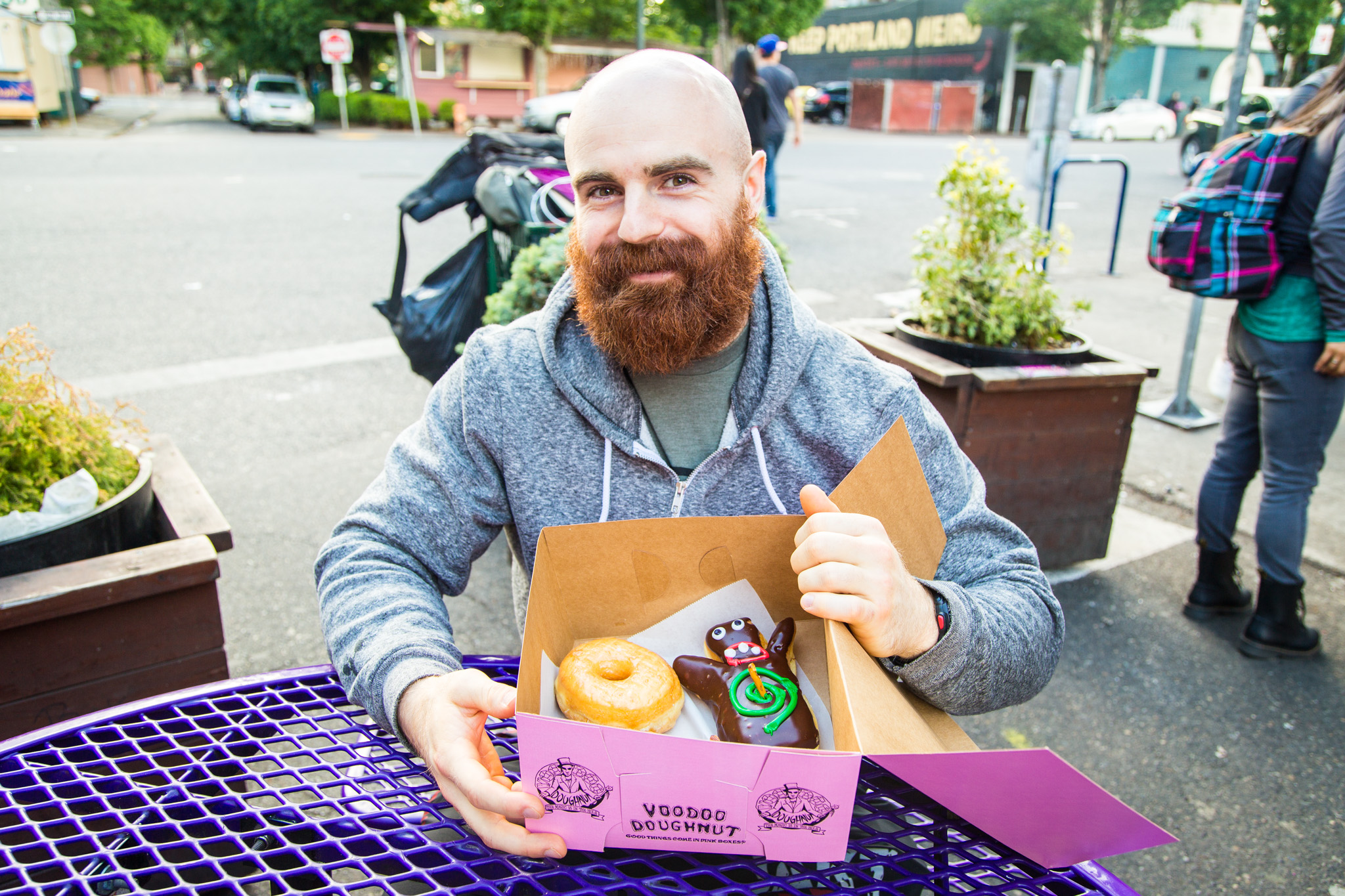
    Celebratory doughnuts. “Keep Portland Weird.”
  • The Truth About The Beard

    I’d like to set the record straight.

    I’m not a hipster. I’m not a lumbersexual. I’m not a grooming enthusiast. Hell, I’m barely a hygiene enthusiast…

    I get a lot of questions about my beard; fair enough, since it is a perceivable physical manifestation of biological processes existing in three-dimensional space, and is as liable to discussion as any other real or unreal thing.

    Pre-lift-CFNV2-FB
    Taking a final deep breath before stepping onto the lifting platform at the CFNV Challenge.

    But that’s pretty much the extent of it. This is just the way I look today.

    When people ask me for facial-hair advice, I don’t know what to say. Growing a beard is one of the easiest things in the world. You just stop touching your face for a few months. Your body’s basic functions will take care of the rest. In this regard, growing a beard may be even easier than pooping. Think about it.

    So many people have trouble pooping, that we have a word for it: constipation. To my knowledge, there is no such word related to beard growing, because growing a beard is easy (although, if such a word were to be required, I humbly submit “con-sti-FACE-ion” as my contribution to the lexicon).

    So, to all you self-proclaimed lumbersexuals, vagabonds (*cringe*), and manly-men: you can cut the crap.

    I used to read men’s magazines. For a while, I counted myself among the hordes that scavenged the pages for any hint at how to act, how to look. How to be myself. Which subtle combo of wristwatch, tie, and socks I should use to “make a statement” (has anyone ever figured out what that statement was, exactly?).

    I no longer subscribe to the notion that “the clothes make the man.” Or that the job title makes the man. Or that a beard makes a man. Or, for that matter, that a “man” is anything more than an XY chromosome profile.

    That guy with the impeccably manscaped chest, the epic, waxed and styled facial hair, and that ridiculous undercut man-bun? You don’t really know anything about him, other than that he’s spent a lot of money on body waxing, beard oil and barbershop appointments. Big whoop.

    This is not to disparage that man. I live and let live. Do whatever brings you joy, bro. I just don’t think we’d have much to talk about at a party. I don’t use pounds of product on my facial hair. I don’t perfume it with designer oils that were concocted by a chemist with soft hands. In reality, most of the time my beard probably smells like sweat, gym chalk, or ocean spray. This is a result of the way I choose to live my life.

    The point of this article is not to tell you how to live your life or groom your beard. The point is to provide insight into why I happen to look the way I do, and to share my personal truth:

    A beard is not itself an ambition. A beard is what happens when you’re busy with more important things.

  • Off Season Plans

    I get a lot of questions about my program and about what a yearly training cycle looks like. So this post will provide some insight into what I’m doing right now: enjoying the off-season.

    The 2015 CrossFit Games reached its explosive conclusion at the end of July. It was a jam-packed season from the start of the Open, through Regionals, and into the finals. Every year, the bar gets raised. Every year, the level of competition reaches a more feverish pitch.

    And every year, I am shocked at what I see on social media after the Games: “2016 starts NOW!”
    “Well, had a great couple days of rest, now time to start training!”
    “back to the grind!”
    This gets posted by rookies and veterans alike, to the enjoyment and approval of the online masses. Well, let me show you the less exciting side of things.

    I usually take a month off after the Games.

    Let’s clarify exactly what that means. I’m not doing “fun training.” I’m not doing a strength program. I’m not jumping into regular classes at the gym. I am taking the month off.

    Here’s the ideal structure of that time, immediately post-games:
    Week 1 – do literally (figuratively) nothing. Eat, sleep, bathe occasionally.
    Week 2 – assess and treat. Take stock of health and structural issues; see doctors, get massages, etc.
    week 3 – reintroduce light movement. Swimming, rowing, rehab and isolation drills… This is what most “normal” people do for exercise.
    week 4 – transition towards training. Start to try more typical movement patterns like weightlifting and gymnastics. No volume or intensity.

    The exact structure of this time is less important than the mindset. The goal for this month is to be totally switched off. I want to soften my focus and let go of all the dials, pulleys, and levers that I’ve been watching like a hawk all year.

    I realize that this is drastically different from what some athletes advertise. Surely, there are a range of personalities at the elite level that require different kinds of stimulation, and different protocols, to feel like they are doing the right thing to get to next year. My decision to take a month off is driven by a few factors: physical, mental, and administrative.

    Physically, I am wrecked after the Games. Many athletes are, but maybe don’t realize it. I’ve had fairly significant injuries in nearly all of my 5 years training for the Games, and the off-season is so short, the competitive season is such a whirlwind, that the only time I really have to truly stop and deload my body is right after the finals. From this perspective, a month is not very long at all. Most serious strains and pains can take 2-3 months to fully rehab. I need to give myself at least a chance to start these healing processes so that they can continue during training in the off-season. From a health and nutrition standpoint, I also like to give my body a break from the massive calorie and supplement consumption that is necessary in-season. Letting the organs and digestive tract rest is important, and really, a month is not very long for this.

    The mental category is a catch-all for social, emotional, interpersonal, and recreational factors. I like to use some time after the Games to act my age… how many 26 year-olds do you know who exercise all day, go to bed early, and avoid sugar and alcohol all year, for little-to-no money or recognition? Some of my best friends from high-school and university still live in my hometown, but I barely ever see them. The family and friends that I do see are spending most of the year watching me withdraw into the focus of my training. I don’t do any fun activities like surfing or skiing because I could end my season in a split-second accident. These are not complaints, but rather conscious sacrifices I have made in pursuit of my goals. However, the spirit can’t thrive on goals alone. So, I like to take some time to stay up late, drink beer, eat junk, and hang out. I feel this release and contrast is necessary, and can help define and feed my focus for the upcoming year.

    Administrative factors are basically all the grownup activities that get neglected during the training year. After the Games, I do my best to rebuild habits of answering emails on time, doing chores, making to-do lists, and generally trying to get my life in order (this is still a work in progress, as my girlfriend Lindsay will surely confirm). I use this down-time to reflect on my training and to brainstorm for the year ahead. What details do I need to polish this season? What changes can I make to improve? This is an organic process that lasts all year, but now is the time to take advantage of creativity, with the mind and body being free and relaxed. I also start to lay the groundwork for off-season projects: travel for events and workshops is how I support myself outside of competition. So, stay tuned to my website and social media for all the fun stuff I’m planning – maybe there will be something near you!

    At the end of the day, every athlete has different tolerance and needs. I feel that my habit of taking a month off after the Games may be slightly unorthodox, but may be instrumental to my longevity as a CrossFit competitor. As a 5-time Games athlete, having 5 months off in 5 years is actually pretty reasonable. To put things in perspective, Olympic athletes compete every 4 years; theoretically, they could take an entire year off to rest and recover, and then still have 3 whole years to train. The CrossFit season hammers harder and heavier every year, so I try to find breaks where I can, in order to stay afloat and find my time to flourish.